.png?width=400&height=120&name=HarrierLogoNew25_400x120_transback%20(1).png "harrierLLC_logo")

AI adoption and maturity overview
Across the U.S. and Europe, AI usage has crossed an important threshold. More than half of working-age adults in the U.S. now use generative AI tools, and roughly one in five European enterprises have adopted at least one AI technology. Small businesses, in particular, are accelerating quickly, narrowing the gap with large firms.
It all sounds great, but in practice, many leaders are reporting the same quiet frustration:
“We’re using more AI, but work doesn’t feel easier.”
Two areas are at the crux of this tension, AI adoption is the extent to which AI tools and systems are introduced, used, and scaled within an organization. In practice, adoption answers questions like:
Are we using AI at all?
In which functions or processes?
How many teams or employees use it regularly?
Adoption is necessary, but it primarily measures presence, not impact.
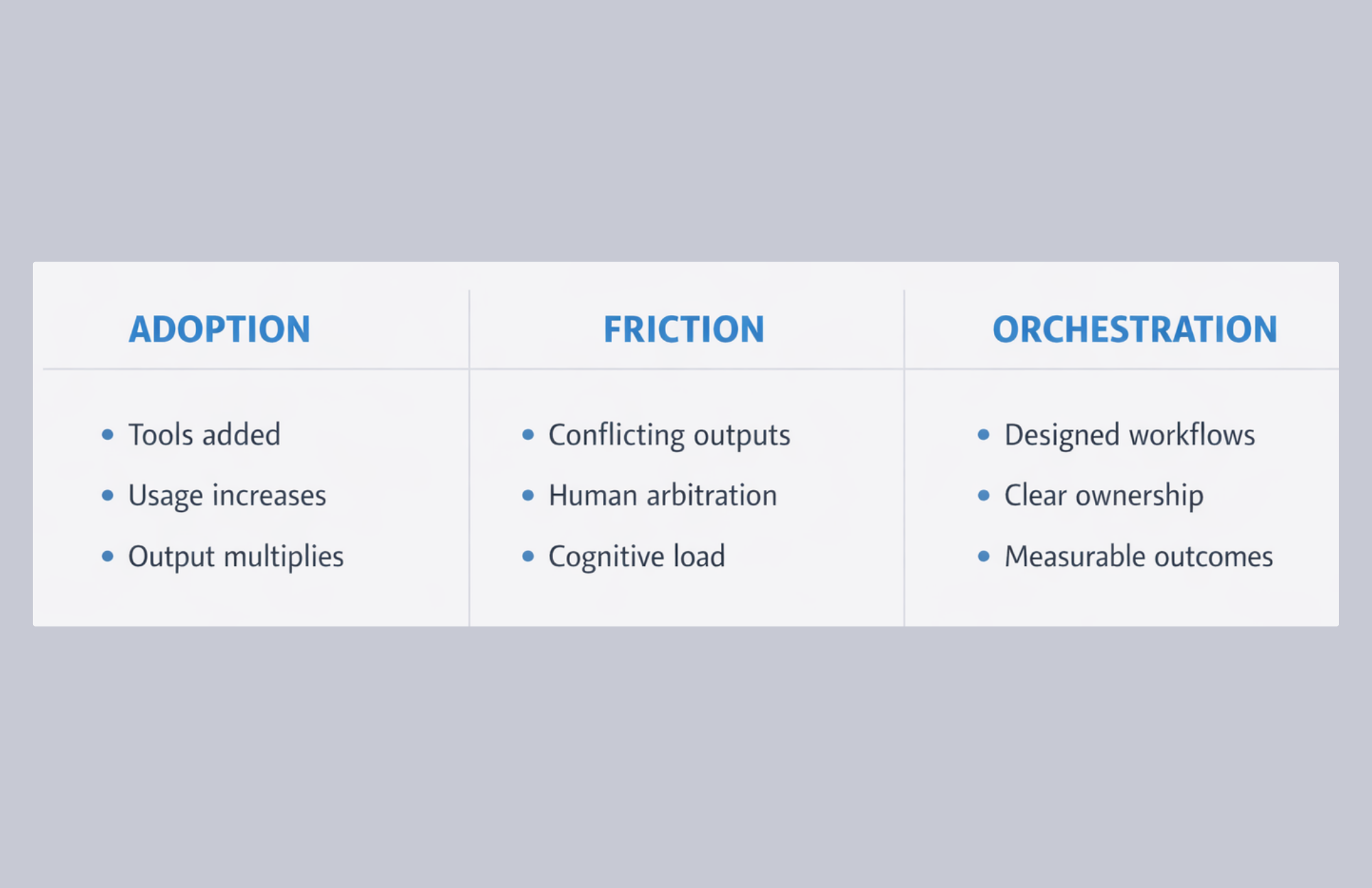
AI orchestration is the deliberate design of work, decisions, and ownership once AI is present.
Orchestration answers questions adoption does not:
What work should never require a human again?
Where must human judgment remain central?
Who owns AI-supported decisions end to end?
How do AI outputs move without constant interpretation?
Which decisions are made once instead of repeatedly?
Operationally, orchestration determines whether AI reduces effort or merely shifts it.
For right now:
AI adoption is about adding AI to the organization. AI orchestration is about redesigning how the organization works because AI exists. What the data shows is that many organizations reach a scenario where AI is live, embedded in multiple functions, and tracked for output. Yet friction often increases.
The tech is new, and still relatively in its infancy. Experimentation is a requirement now. You can't employ new ways of thinking without learning how to think differently, you have to retrain your entire work-brain.
AI is almost always added on top of workflows that were never designed for it in the first place.
Orchestration does not equal infrastructure
Orchestration is often mistaken for infrastructure. APIs, middleware, integrations matter, but they’re not the main point. Operationally, orchestration is work design.
It is the deliberate act of deciding:
-
What should never require a human again
-
Where human judgment is essential
-
Who owns AI-supported decisions end to end
-
How outputs move without constant interpretation
-
Which decisions are made once instead of repeatedly
The challenge, especially for small organizations, is to understand that you may need to change how you approach work in fundamentally different ways.
Orchestration is the missing layer of AI maturity
Most AI maturity models measure readiness, scale, and strategic intent. What they rarely measure is whether work is actually getting easier.
The research shows that high-maturity organizations share two defining traits:
• Centralized ownership of AI strategy and governance
• Explicit redesign of workflows around AI capabilities
In other words, when built over time, orchestration becomes the layer between humans and AI, like the lubricant of an engine.
For small organizations, keep an eye out for…
Large organizations can absorb inefficiency, but small teams are more vulnerable to loss of revenue and good people from the tension created by inefficiencies.
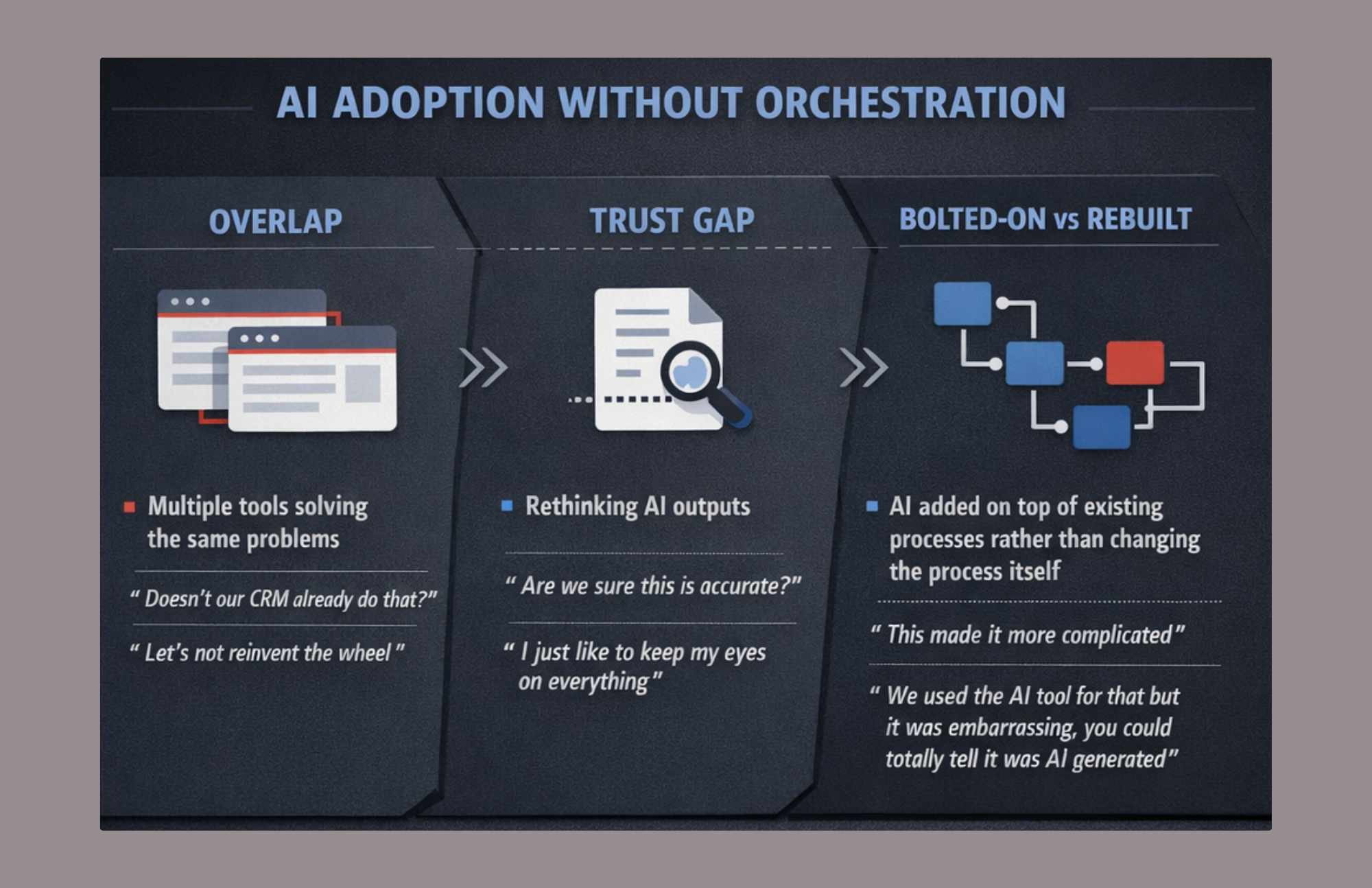
For teams under 20 people, AI adoption without deeper orchestrations shows symptoms like:
Overlap: Multiple tools solving the same problems
Things you’ll hear: “Doesn’t our CRM already do that?” or “Let’s not reinvent the wheel”
Trust gap: rethinking AI outputs
Things you’ll hear: “Are we sure this is accurate?” and “I just like to keep my eyes on everything”
Bolted-on vs. rebuilt: AI added on top of existing processes rather than changing the process itself
Things you’ll hear: “This made it more complicated” or “we used the AI tool for that, but it was embarrassing, you could totally tell it was AI-generated...".
Key takeaways for small organizations:
The promise of AI isn’t sophistication or custom models. They have unique traits:
-
Small teams don’t have layers to absorb inefficiency. When AI is bolted onto unclear workflows, leaders become bottlenecks, trust erodes quickly, and the cost of “getting it wrong” feels personal. But when orchestration is done well with explicit boundaries between human judgment and machine effort, AI does what it’s supposed to do: it removes noise.
- AI adoption introduces capability. AI orchestration determines whether that capability actually improves how work gets done.
-
The leaders who see results aren’t asking 'what else AI can do?". They’re asking a harder, more operational question: What should never require a human again and what must always remain human?
That answer, more than any tool choice, is where real building begins.
References
McKinsey, Europe's AI Opportunity, 2024.Coherent Solutions, AI Adoption Trends 2025, 2025.
The Decision Lab, Management: AI Maturity Models, 2025.
USAII, Understanding AI Maturity Levels, 2025.
Primotly, EU vs USA AI: Who Will Lead?, 2025.
World Economic Forum, Europe AI Adoption Lag, 2025.
Nature, Good AI Society: US vs EU Strategies, 2024.
G2, AI Maturity Model: Five Stages, 2025.
Deloitte, State of Generative AI in Enterprise, 2025.
Gartner, Hype Cycle for AI, 2025.
Gartner, AI Strategy Pillars, 2025.
Gartner, AI Maturity Model Toolkit, 2025.
McKinsey, The State of AI in 2025, 2025.
SBA, Research Spotlight: AI in Small Business, 2025.
US Census Bureau, Business Trends and Outlook Survey (BTOS), 2025.
US Census Bureau, Employer Business AI Adoption, 2023.
St. Louis Fed, State of Generative AI Adoption 2025, 2025.
Eurostat, Use of AI in Enterprises (2025 Edition), 2025.
Eurostat, AI Adoption Statistics explained, 2025.
Eurostat, AI Adoption Rates by EU Countries, 2025.
Congressional Research Service, US vs EU AI Comparison, 2025.
Accenture, Europe Seeking AI Sovereignty, 2025.
Gartner, Organization AI Maturity Survey, 2025.
Stanford University, 2025 AI Index Report, 2025.
McKinsey, Europe's AI Competitiveness, 2024.
IMF, Macroeconomic Impact of AI in Europe, 2025.
IJSRET, JPMorgan AI Investment Metrics, 2024.
Medium, JPMorgan COiN Case Study, 2025.
5D Vision, JPMorgan AI Transformation, 2025.
Bloomberg / ComplexDiscovery, JPMorgan Software vs Lawyers, 2017/2025.
FullView, AI Statistics & Industry Roundup 2025, 2025.
GreyB, Walmart Tech-Centric Strategy, 2025.
Artic Sledge, Retail AI Case Studies (Walmart/Target), 2025.
Walmart Corp, Partnership with OpenAI, 2025.
Digital Defynd, Sephora Using AI Case Study 2025, 2025.
Cognitute, Sephora: Digital-First Omnichannel Powerhouse, 2025.
Glance, AI Shopping App Case Study, 2025.
YouTube / Sephora Search Analytics, AI Generated Landing Pages, 2019/2025.
DartAI, Pfizer Digital Transformation Strategy, 2025.
Chief AI Officer Blog, Pfizer 30-Day Drug Discovery, 2025.
SmartDev, AI Use Cases in Drug Discovery, 2025.
Mayo Clinic News, AI Detector of Silent Heart Disease, 2019/2025.
Inferscience, History of AI in Healthcare, 2025.
Siemens AG, How AI is Revolutionizing Industry, 2024.
ARC View / Siemens, Industrial Edge for AI, 2025.
IIoT World, Siemens Erlangen Factory Practice, 2025.
AMA / NEJM Catalyst, AI Scribes Save 15,000 Hours, 2024/2025.
Deloitte, US Retail Industry Outlook 2025, 2025.
ITU, Annual AI Governance Report 2025, 2025.
Flexential, 2025 State of AI Infrastructure, 2025.
IBM, 5 Biggest AI Adoption Challenges, 2025.
OECD, AI Principles and Transparency, 2024.
Deloitte, Enterprise Challenges for AI Agents, 2025.
Svitla, AI Digital Transformation ROI, 2025.
PYMNTS, Johnson & Johnson AI Value Concentration, 2025.