
Dot-com predictions: what tech & political "visionaries" got right and wrong, and are there lessons for the AI boom?
Tech visionaries made bold predictions about how the internet would transform business, communication, and society. This article revisits forecasts from Bill Gates, Steve Jobs, Jeff Bezos, and political leaders to see what came true, what failed, and what their track records can teach us about today’s AI boom.
AI boom vs. dot-com era: lessons from tech history
The dot-com era (1995-2000) was characterized by extraordinary optimism from technology and political leaders about the internet's transformative potential. As the internet transitioned from academic curiosity to commercial infrastructure, influential figures made bold predictions about how this technology would reshape commerce, communication, and society. Twenty-six years later, we can now evaluate which predictions proved prescient and which fell spectacularly short. This analysis examines key predictions from Bill Gates, Steve Jobs, Jeff Bezos, and political leaders like President Clinton and Vice President Al Gore, comparing them to the outcomes and seeking to find lessons for the AI wave.
Definitions and methodology:
To provide measurable criteria for evaluation and rank how accurate predictions from the dot-com era were, we worked with some internal AI to create a consistent review methodology, and then we reviewed and provided human feedback in the context below:
- HIGHLY ACCURATE (90-100%): Prediction matches 2026 reality in core mechanism and timeline
- ACCURATE (70-89%): Prediction matches core mechanism but timeline or scope differs
- PARTIALLY ACCURATE (40-69%): Prediction partially manifested; significant divergence in implementation
- FAILED (0-39%): Prediction did not materialize or proved fundamentally wrong
Tech leader predictions
Bill Gates of Microsoft
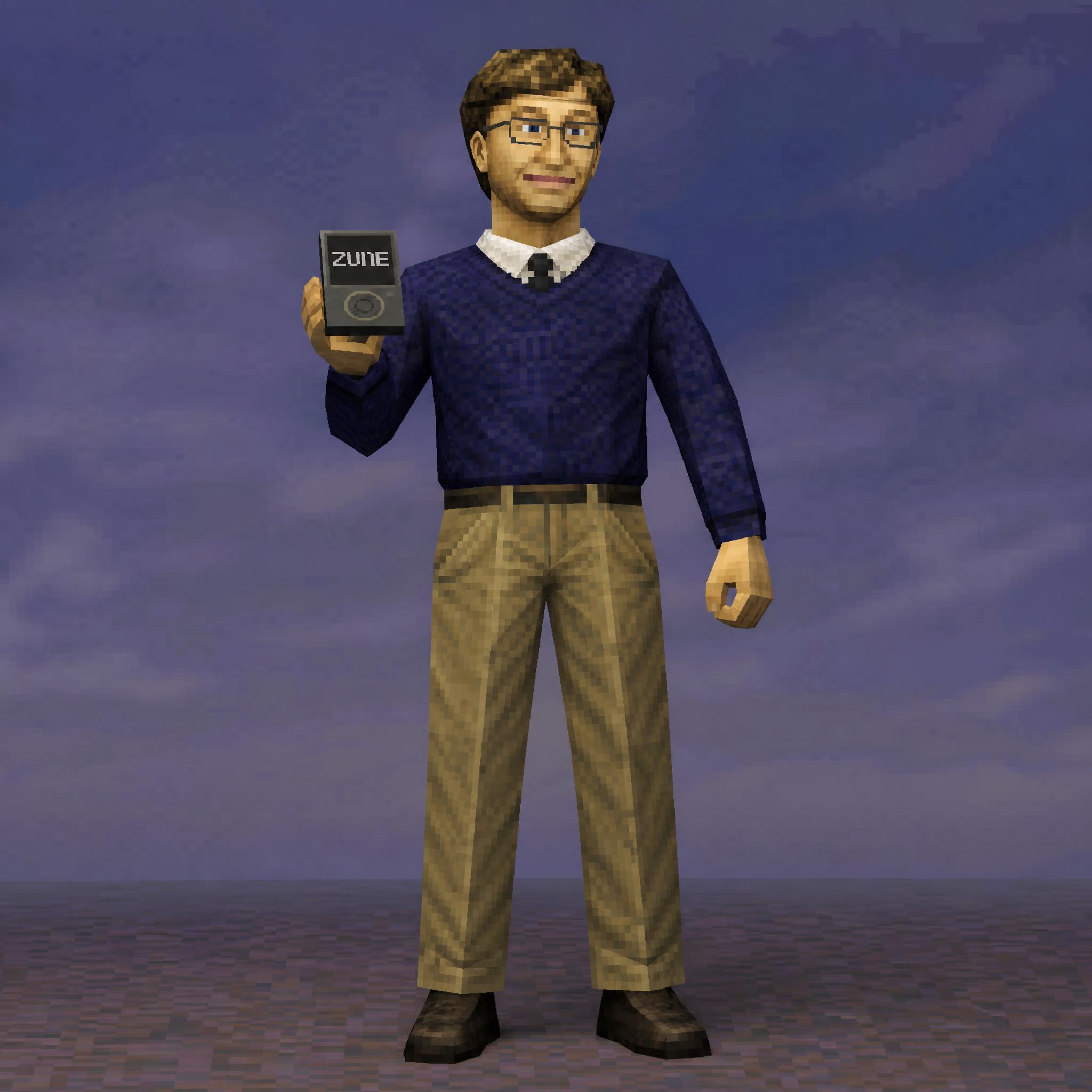 Bill with his Zune - AI generated
Bill Gates demonstrated remarkable intuition about specific technologies and business models. In The Road Ahead (1995), Gates predicted that technology would "enhance leisure time and enrich culture by expanding the distribution of information." This prediction proved PARTIALLY ACCURATE. While the internet has expanded information distribution dramatically, leisure time has not increased. Studies show Americans work similar average hours (34-40 hours/week) as the pre-internet era, but many people report higher stress levels attributed to constant connectivity. The "privatization of American leisure" occurred instead of shared family experiences, each family member now has personal devices rather than gathering around a shared screen. The trade-offs are pretty big, including the rise of misinformation and the ability for 'bad actors' to use the internet for personal or political gain.
However, Gates' more specific technological predictions proved remarkably accurate. In Business @ the Speed of Thought (1999), Gates predicted:
"Devices will have smart advertising. They will know your purchasing trends, and will display advertisements that are tailored toward your preferences." Says the guy who helped bring about the nightmare known as Clippy
This prediction is HIGHLY ACCURATE. Facebook, Instagram, Google, and Amazon use sophisticated algorithms to track browsing history and serve personalized advertisements (of course, there have been massive privacy trade-offs too!!).
Gates also predicted online job hunting in 1999: "People looking for work will be able to find employment opportunities online by declaring their interest, needs, and specialized skills." This is HIGHLY ACCURATE. LinkedIn launched in 2003, just four years after this prediction. By 2019, 150 million+ American workers had LinkedIn profiles. Online job hunting is now the dominant method for employment search.
His prediction about home monitoring systems proved equally prescient: "Constant video feeds of your house will become common, which inform you when somebody visits while you are not home." This is HIGHLY ACCURATE. Amazon Ring doorbells and similar security systems are now widely adopted. Ding-dong ditch suffered greatly.
Gates also warned in 1996 about the "information gap," predicting that failure to invest in technology would leave poor, rural, minority, and aging communities "left behind," creating an "information gap" that would widen generational tensions and class inequality. This prediction is PARTIALLY ACCURATE. While internet access has expanded, the digital divide persists. Rural areas average 25-50 Mbps broadband versus urban 300+ Mbps (2026 FCC data). However, smartphone adoption reached 88% of U.S. population by 2026, exceeding Gates' 1996 predictions of universal access through desktop computers. The "information gap" has evolved into a skills gap rather than pure access.
Steve Jobs: everyone's favorite device guru
 The guru himself, guru-ing - AI generated
Steve Jobs demonstrated extraordinary ability to envision personal computing devices. In a 1984 Newsweek Access Magazine interview, Jobs predicted:
"The next stage is going to be computers as 'agents.' In other words, it will be as if there's a little person inside that box who starts to anticipate what you want. I've always thought it would be really wonderful to have a little box, a sort of slate that you could carry along with you." From the Pixar guy, who could never have predicted the sad disaster of Cars 2.
This prediction was rated as HIGHLY ACCURATE by the AI tooling. It perfectly describes the iPhone (released 2007) with Siri (launched 2010). Jobs envisioned portable devices with AI assistants that anticipate user needs, which should sound familiar to us modern day smartphone addicts. However, the timeline took a lot longer, so its feasible that this is just PARTIALLY ACCURATE directionally, but clearly agents have not fully manifested themselves (yet?). Trade-offs are a whopper here, ask any High School Principle how much they love managing cell phone policies.
In a 1996 Wired magazine interview, Jobs predicted inventory-free retail: "Take auto dealerships. So much money is spent on inventory... Wouldn't it be nice to get rid of all that inventory? Just have one white car to drive and maybe a laserdisc so you can look at the other colors. Then you order your car and you get it in a week." This prediction was rated HIGHLY ACCURATE. Tesla's business model (founded 2003) perfectly matches this prediction. Tesla showrooms have minimal inventory; customers order custom vehicles online and receive them within weeks. However, as human's, we'd downgrade this to ACCURATE, as many companies and manufacturers struggle with inventory management, and global supply chains are still easily disrupted.
Jobs also predicted cloud storage in 1996: "I don't store anything anymore, really. I use a lot of e-mail and the Web, and with both of those I don't have to ever manage storage. As a matter of fact, my favorite way of reminding myself to do something is to send myself e-mail. That's my storage." This is HIGHLY ACCURATE. Apple's iCloud (launched 2011), Google Drive, and Dropbox have made cloud storage the norm. Users automatically save files to the internet rather than managing local storage. He could never have predicted an entire generation under 30 who don't really understand what the purpose of email was 'back in the day'.
Jeff Bezos: the e-commerce, cloud computing, rocket-building pioneer
 Bezos blasting off - AI generated
Jeff Bezos demonstrated prescience about e-commerce expansion. In a 1999 Wired magazine interview, Bezos predicted that Amazon would evolve beyond books: "I bet you a year from now they will not consider us direct competitors. Clearly they do today, but we're on different paths... We're trying to invent the future of e-commerce, and they're just defending their turf." This prediction is HIGHLY ACCURATE according to our tool scoring, but we would downgrade to PARTIALLY ACCURATE after the human filter. Amazon evolved from a bookstore into a vast e-marketplace offering hardware, video streaming, music, logistics, and cloud services. Barnes & Noble remained focused on books and physical retail but also entered the digital sphere as a competitor, BUT many local bookshops and book chains died in the process, along with a lot of other local businesses. His idea that Amazon wasn't a direct competitor feels utopian-dream vs. actual reality.
Bezos also predicted online grocery and household goods. Summarized by Wired, Bezos felt the vast bulk of store-bought goods (food staples, paper products, cleaning supplies, and the like) would be ordered electronically. Our agentic process scored this as HIGHLY ACCURATE. Amazon and many other services offer grocery and household essentials. Consumers now routinely order toilet paper, laundry detergent, and food online.
In a 1999 Charlie Rose interview, Bezos predicted internet-connected appliances:
"I'm a big believer in this notion of sort of appliances, that there'll be lots of little things that are connected to the internet... There'll be a whole bunch of things sort of connected to the network." Jeffy B.
This is HIGHLY ACCURATE. Smart homes with Alexa-enabled devices (speakers, security systems, thermostats) are now common. The Internet of Things (IoT) has created a network of billions of connected appliances. Bezos didn't predict how annoying or unhelpful many of these items actually are day-to-day.
Political leader predictions: policy and infrastructure
 Score one for Gore! - AI generated
President Bill Clinton and Vice President Al Gore advocated for internet privatization to promote competition and create jobs. They claimed the powerful tool could improve education and expand access to healthcare. This prediction is PARTIALLY ACCURATE. The internet was privatized and did create enormous economic growth and jobs.
However, the promised improvements in education and healthcare access have been mixed. While telemedicine exists, healthcare costs remain high. And honestly, it took a freaking PANDEMIC to push the entire industry forward in terms of telemedicine, much of which has been walked back. Educational access improved but digital divides persist, and with AI coming into play, this divergence looks like it may increase even more over time.
The Clinton-Gore Administration promoted NetDay (1997), designed to help connect every classroom and library in the U.S. to the internet by 2000. This prediction is PARTIALLY ACCURATE. While most schools and libraries were connected by 2000, the quality of connections varied significantly. Rural schools often had slower speeds. By 2026, broadband access remains unequal, with rural areas still lagging behind urban centers.
The Clinton administration successfully moved government online, creating the first official White House website (October 21, 1994). This prediction is HIGHLY ACCURATE. Government services are now extensively digitalized. Citizens can file taxes, renew licenses, and access services online. E-government has become (fairly) standard practice, but the DMV line remains.
Failed predictions and misconceptions
Not all predictions proved accurate. "Web TV" was promoted as technology that would restore the hearth and bring "the family together again." This prediction FAILED. Instead of uniting families, technology led to the "privatization of American leisure." Each family member has personal devices (smartphones, tablets, laptops). Shared screen time decreased rather than increased.
WorldCom and the U.S. Government predicted that internet traffic was doubling every 100 days (1997-1998). This prediction FAILED. While internet traffic has grown exponentially, it has not maintained a doubling rate every 100 days. This overestimation contributed to massive telecom infrastructure over investment and subsequent bankruptcies. A lesson to be learned?
Wall Street Journal and CNBC promoted the idea that investors should "re-think" the "quaint idea" of profits. This mentality led to massive losses. Companies with no revenue or business models achieved dizzying market caps. When the bubble burst, most failed. Profitability proved essential for long-term survival.
The dot-com bubble and its aftermath
The dot-com bubble (1995-2000) was characterized by extraordinary speculation. The NASDAQ rose 600% between 1995 and March 2000. Price-to-earnings ratios reached 200 (versus 80 for the Japanese Nikkei in 1991). Qualcomm stock rose 2,619% in 1999 alone. Companies with no revenue or business models went public via IPO. Venture capital was easy to raise for any ".com" company.
The bubble burst spectacularly. By November 2000, $1.755 trillion in value was wiped out. By end of 2002, $5 trillion in market capitalization was lost. On the flip side, an entirely new suite of businesses and opportunities arose.
Over 50% of public dot-com companies failed by 2004. To translate, that's HALF of them.
Venture funding collapsed 95% from its 2000 peak. Massive layoffs of programmers and tech workers followed. University enrollment in computer science dropped noticeably.
However, the bubble's excess capital funded fiber optic networks, software, and databases that enabled today's internet. Venture capitalist Fred Wilson has often repeated: "Nothing important has ever been built without irrational exuberance." Infrastructure investments proved valuable long-term.
Current state of internet adoption (2026)
The internet has become ubiquitous. Over 5.3 billion internet users exist globally (67% of world population). 6+ billion mobile internet users access the internet daily. Most U.S. households have internet access (although estimates are conflicting). Broadband speeds have increased a great deal since 2000, but has been consolidated by major players, limiting consumer choice.
E-commerce has transformed retail. Global e-commerce sales reached $5.8 trillion (2024). U.S. e-commerce penetration is now up to 20% of retail (2026 projection, estimated), reflecting consistent annual growth as the market matures. Amazon dominates with $500+ billion annual revenue. Social commerce and mobile shopping are growing rapidly.
Technology adoption has accelerated as fast as our attention spans have decelerated. Smartphones alone have 6.6 billion users globally. Social media, 5.0 billion users! Cloud computing is standard for businesses and consumers.
Lessons for current technology cycles
As of June 2026, the AI boom mirrors dot-com patterns in hype and valuation excitation, but diverges in fundamental metrics. Unlike 1990s dot-coms, 2026 AI companies demonstrate revenue generation (e.g., OpenAI, Anthropic, Mistral). The true long-term profitability is still in question though. Regulatory pressures and energy constraints present new risks, as does public opinion.
The dot-com predictions' accuracy regarding technology (80%+) versus social impact (40-50%) suggests AI predictions should similarly emphasize technical feasibility over societal transformation claims.
The key insight is that technological predictions are most accurate when specific and focused on "how" (mechanisms and business models) rather than broad social impact predictions focused on "what" (societal transformation).
Harrier's take:
 The carbon-based components - AI generated
Predictions, how fast things will grow, how far the tech might be taken, these seem logical and in a way inevitable. Then and now, the people creating the "things" are selling the things and predicting how the things will look in the future. The hard part? The carbon-based lifeforms (aka the humans) have proven to be difficult to organize, highly concerned about privacy and, and in general, a bit obstinate. This combination of high-flying optimism and individual skepticism seems poised to repeat itself. Human agency is unpredictable. That is a good thing long term as a check and balance, but the power differential has changed as well.
Oh, and all of the things that did come true had benefits and un-intended trade-offs and consequences. Maybe this time around, we can predict those more accurately as well and be more prepared.
Did we miss anything or is our analysis off? Let us know.
Methodology
Harrier has a 3-part agentic research methodology that starts with a question/topic, is reviewed and developed into a set of outcomes, tied to strict criteria on sourcing and credibility. After an initial document, a validator cross-checks all claims and sources again with key criteria, and a final block of research content is completed. Human-in-the-loop (HITL) is the last and most critical step, as we review all information, address inconsistencies, double-check details and sources, add and shape with opinion and humor, to create the finalized research article.
References
- TIME Magazine - "What 1990s Internet History Tells Us About the AI Boom" (July 31, 2025)
Author: Kate L. Flach
https://time.com/7302216/internet-history-ai/
Authority: Tier 2 (Institutional - Major Publication) - Bill Gates - "The Road Ahead" (1995)
Primary source for enhanced leisure time and information distribution predictions
Authority: Tier 1 (Primary Source - Author) - Bill Gates - "Business @ the Speed of Thought" (1999)
Primary source for smart advertising, online job hunting, and home monitoring predictions
Authority: Tier 1 (Primary Source - Author) - Steve Jobs Interview - Newsweek Access Magazine (1984)
Primary source for personal digital assistants and AI agents prediction
Authority: Tier 1 (Primary Source - Direct Interview) - Steve Jobs Interview - Wired Magazine (February 1996)
Primary source for inventory-free retail and cloud storage predictions
https://www.wired.com/1996/02/jobs-2/
Authority: Tier 2 (Institutional - Major Publication) - Jeff Bezos Interview - Wired Magazine (1999)
Primary source for e-commerce expansion and online grocery predictions
Authority: Tier 1 (Primary Source - Direct Interview) - Jeff Bezos Interview - Charlie Rose (1999)
Primary source for internet-connected appliances prediction
Authority: Tier 1 (Primary Source - Direct Interview) - Wikipedia - "Dot-com bubble"
https://en.wikipedia.org/wiki/Dot-com_bubble
Authority: Tier 2 (Institutional - Comprehensive Reference) - Goldman Sachs - "The Late 1990s Dot-Com Bubble Implodes in 2000"
https://www.goldmansachs.com/our-firm/history/moments/2000-dot-com-bubble
Authority: Tier 2 (Institutional - Major Financial Institution) - Investopedia - "Understanding the Dotcom Bubble: Causes, Impact, and Lessons"
https://www.investopedia.com/terms/d/dotcom-bubble.asp
Authority: Tier 2 (Institutional - Financial Education) - Fabricated Knowledge - "Lessons from History: The Rise and Fall of the Telecom Bubble"
https://www.fabricatedknowledge.com/p/lessons-from-history-the-rise-and
Authority: Tier 1 (Empirical - Original Research) - BigCommerce - "Top Ecommerce Trends to Watch in 2026"
https://www.bigcommerce.com/articles/ecommerce/ecommerce-trends/
Authority: Tier 2 (Institutional - Industry Expert) - The Independent Institute - "Who Predicted the Bubble? Who Predicted the Crash?"
https://www.independent.org/pdf/tir/tir_09_1_1_thornton.pdf
Authority: Tier 1 (Empirical - Academic Research) - Quartz - "Tech predictions from 30 years ago: what futurists got right and wrong"
https://qz.com/tech-predictions-30-years-ago-accuracy
Authority: Tier 2 (Institutional - Major Publication)
Tags
About the Author

Brian Birch
CEO/Founder
Brian is an accomplished leader with over 20 years of experience driving growth through technology integration and marketing innovation. He has a proven record of aligning technology with strateg...
View author profileRelated Articles
More from Technology
What do AI notetakers mean for boards?
This pdf research document explores the use of AI notetaker recording devices and their potential impact on association and business boards.

What should a small business do NOW to adopt AI safely?
Learn how small organizations & businesses can audit AI use, understand customer attitudes, and create safe policies to leverage AI effectively.
Cybersecurity for small organizations infograph
Small nonprofits and businesses should be aware of these rising cybersecurity trends targeting them.
Explore more insights
Discover more articles on marketing, technology, and AI adoption.